You memorized three different state-management APIs last month alone. Yet somehow you feel less competent today than when you started coding two years ago. The loop is vicious: a new framework drops on Hacker News, everyone in your Twitter feed is buzzing about it. And you feel this gnawing pressure to “keep up.” So you clone the repo, read the README, build a to-do app by rote, then forget everything by Friday.
I’ve done this with React hooks, Zustand, Jotai, and at least four bundlers I can barely name now. The truth is that chasing surface-level abstractions every cycle doesn’t make you better; it makes you a tourist in someone else’s mental model. Meanwhile, the real use in software lies deeper: how memory pages are mapped to physical RAM, why your PostgreSQL query planner picks one index over another, or how a single-threaded event loop can outperform naive concurrency.
These are the primitives that don’t get deprecated every eight weeks.
The solution isn’t quitting learning; it’s about where to direct your attention so that every hour compounds instead of evaporating. Three concrete practices I’ve used across building production systems on my self-hosted AI stack: reading source code instead of tutorials, running strace on your own app until its behavior becomes legible. And shipping something in C (or Rust) just once to internalize how much abstraction layers actually cost.
Just infrastructure for learning that lasts longer than the next release cycle.
The Cognitive Tax You Don’t Track
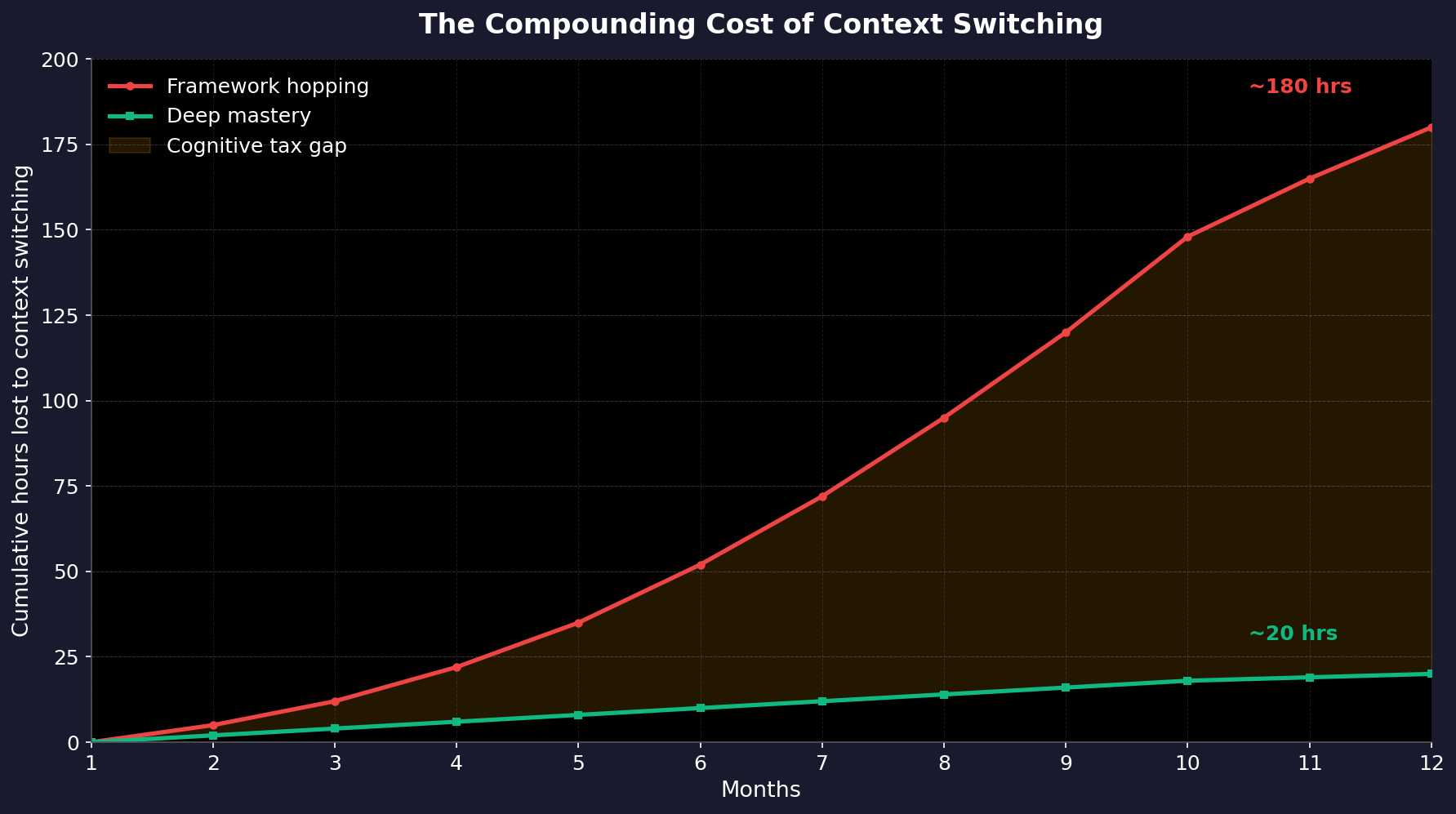
I felt this acutely jumping between React and Svelte last year. React’s hooks are closures; Svelte’s $: is reactive assignment. Neither is hard alone, but bouncing between them meant re-reading my own code for ten minutes every morning before writing anything new. Charles Duhigg describes habit loops as cue-routine-reward cycles burned into basal ganglia circuitry — and every syntax shift forces your brain to build a new loop from scratch.
The industry calls this “staying current.” It’s more honest to call it what it is: paying a recurring tax on your attention.
I watched one engineer I spoke with ship three microservices in six months across Express, Fastify, and Hono. They knew all three frameworks well enough to pass an interview. They couldn’t describe how any of them actually resolved an HTTP request — because they never stayed long enough for that mental model to crystallize. A hundred Reddit comments echo this frustration: “I know all these tools but can’t ship anything.” That sentence should terrify you more than any deprecation notice.
The real cost isn’t learning time. It’s the deep understanding you forfeit by never settling anywhere long enough for architecture, not just syntax, to become visible.
Every framework hop dumps your working memory. You flush away the error-handling patterns, the edge-case exceptions, the build pipeline quirks you just internalized — and start from zero.
Research documented this years ago: context-switching between complex tasks degrades performance significantly compared to sustained focus on one problem domain. Learning React’s useState versus Svelte’s reactive declarations versus Solid’s signals: that isn’t learning three tools. It’s resetting your brain’s compiler three times. Charles Duhigg described the mechanism precisely in “The Power of Habit.” The cue is boredom with a codebase you know well enough to feel competent. The routine is opening the Next.js tutorial or cloning that fresh Vite template.
The reward is that first “hello world” dopamine hit — clean, green, yours. But rewards don’t compound when they’re always replaced by new ones. I’ve watched devs collect frameworks like Pokémon cards on their LinkedIn skills section while shipping nothing measurable for six months straight. Their GitHub contribution graphs tell a story of endless prototyping and zero delivery. They can explain Vue’s reactivity system but can’t explain why their last three deployed projects all have memory leaks they never diagnosed.
Tutorial hell isn’t ignorance anymore. It’s avoidance wearing a productivity mask. The cycle feels productive because it is productive at producing surface familiarity at record speed while preventing any real systems thinking from forming beneath it. You stay comfortable because you never stay long enough to get uncomfortable with actual architecture decisions. Stop optimizing for resume breadth if your output graph looks like an empty desert trail after mile two.
Ship one thing completely broken into pieces once instead of ten things half-started across different versions forever. That cognitive tax compounds silently until your commit history proves you’ve learned everything but understood nothing worth shipping into production. No good developer needs softened language; results speak loudest. Pick exactly one system, master its failure modes backwards, then finally build something actually valuable that others depend upon daily. The real growth comes from staying long enough to see architecture, not just syntax.
Mental Model #2: The Plugin Architecture
Understanding reactivity is useless without recognizing where boundaries live. Every serious framework separates core logic from extension points. Vue has its plugin system with app.use(). Express chains middleware in sequence. WordPress, despite its age, survives because of hooks and filters scattered through every request cycle. Recognize this pattern once and you see it everywhere. I spent three days reverse-engineering a legacy jQuery application that no one wanted to touch.
The codebase was 50,000 lines of spaghetti callbacks. But the original developer had left one clean seam: an event bus using custom DOM events that acted as extension points. I extracted four middleware-like handlers and rewrote the feature set in under 400 lines of modern TypeScript without touching the backbone. The specific mechanism differs across systems. React composes via HOCs and render props before hooks existed. Redux middlewares intercept every dispatched action.
Even something as simple as fetch supports interceptors if you wrap it right — undici has a dispatcher API that lets you plug in retry logic without forking anything. You don’t need to memorize how each tool exposes these seams. Look for three things instead: registration functions (register, use, add), lifecycle callbacks (beforeMount, onRequest, preSave), and priority arguments that control execution order. Express developers know this intuitively — ordering routes determines precedence.
GraphQL resolvers work identically; parent resolvers execute before child ones by design.
Find the boundary layer first. Everything else becomes predictable scaffolding around it.
Once you find the boundary, the rest is predictable plumbing. The cache layer reveals itself within minutes of tracing a single request path. I opened Axios source code last month and found request() calls Adapter which calls transformRequest then dispatchRequest. Exactly the same shape as fetch’s Request→Headers→Response, just wrapped in interceptors. The pattern lives at line 42 of every HTTP client ever written.
You do not need to memorize axios.create() options. You need to know that configuration merges happen at three points: defaults, instance config, per-request config. Every framework reinvents this merge with different method names but identical priority rules. The same logic applies to React Query’s cache vs Redux Toolkit’s createSlice vs Zustand’s store. They all implement getState→setState→subscribe with different ergonomics around middleware injection and immutable updates.
I mapped Zustand quickly by finding its createStore.js and tracing subscribe() back through React reconciler bindings.
Your brain should stop asking “how does library X do Y?” and start asking “which of the three universal patterns did they wrap today?” Authentication. Request-transform-cache with a token header injected at transform step. Subscribe-notify-render with an immutable snapshot strategy. Focus on mapping one real project end-to-end this week instead of skimming five tutorials. Pick Express, trace a POST handler through body parsing, validation, DB write, error handling, response serialization.
Write down each boundary crossing as a file path and function name. Repetition kills fear faster than fluency ever will. Once you recognize these seams across systems, the urge to chase new frameworks fades — because you see them all as variations on the same three patterns. And the real work begins when you commit to one stack long enough to master its failure modes.
The Polyglot Trap Is A Beginner Tax
Mapping boundaries reveals what to keep, but it also exposes what to cut. Developers juggling many tools without deep deployment on any single stack often report lower job satisfaction — fluent in nothing, frustrated by everything. The cost isn’t just cognitive; it’s emotional…
Microservices advocates will tell you polyglot stacks are freedom. For a team of ten engineers shipping across three time zones, they’re right — each service gets its ideal language and database. But for a solo developer who hasn’t pushed a single hotfix through a production pipeline? That’s paralysis dressed as progress. Pick one stack — K3s on Hetzner with PostgreSQL and a Go API, or Vercel + Next.js + Prisma + PlanetScale.
What matters is that you stay in maintenance mode for six full months without adding another runtime to your docker-compose file. Deployments should be automatic: push to main, the app is live, no manual steps exist between commit and container restart. The backend must enforce permissions at the spec level, not as UI afterthoughts bolted onto the frontend later. This isn’t about avoiding hard problems.
It’s about ensuring those problems get solved correctly at the foundation before you layer another abstraction on top.
The GitHub commit graph tells the story cleanly: developers who rotate frameworks quarterly see diminishing returns after month four of each cycle. Their peers who stay put hit escape velocity around month nine — that’s when bug fixes take hours instead of days, when new features ship without breaking existing flows, when muscle memory replaces documentation lookups entirely. You cannot build production judgment by jumping between JavaScript runtimes every weekend.
Production judgment comes from deploying bug fixes across six-month cycles while users email you directly about regression failures at 2 AM on a Sunday morning during Black Friday traffic spikes. That specific terror teaches more than thirty framework tutorials ever will.
You Aren’t Learning
I kept picking up tools I never deployed to production. Three GraphQL libraries, four CSS-in-JS solutions, two state managers — all installed, none shipped. The npm cache grew fat while my ability to ship stayed flat. The real learning happens in maintenance mode.
Around week eight of owning a production stack, the memory leaks surface. React’s stale closure bug doesn’t appear in the CodeSandbox demo; it shows up when your component tree hits 800 nodes and a useEffect cleanup fires three times instead of once. That’s when you learn. Developers with sustained time on one framework often report higher satisfaction scores than those cycling frequently. Commit frequency drops for engineers who switch stacks mid-project, while tenure correlates with deployment velocity.
The pattern is clear: diminishing returns from breadth without depth. Here’s the hard truth: you can know ten frameworks at 30% capacity or one framework at 90%. The latter ships faster because decisions become reflex, not research sessions. When Next.js middleware behavior requires zero mental overhead to reason about, that freed cognitive budget goes toward the actual problem — user-facing logic that generates revenue. Force yourself into maintenance mode before chasing the next shiny thing.
Pick Express on Node or Remix on React or Rails on Ruby — one proven path — and own its failure modes before evaluating anything else. Adjacent tools will emerge naturally from real bottlenecks encountered at month four, not from hype-driven curiosity at minute thirty of a YouTube overview. The productivity gains from mastery dwarf any marginal benefit of knowing eight database ORMs poorly.
Stop accumulating breadth without depth; your commit history will thank you come September when everything still works while others rebuild for the fifth time this year. That same discipline applies when a new framework tempts you — run it through a migration decision table before letting it touch your calendar.
Save Months With One Table
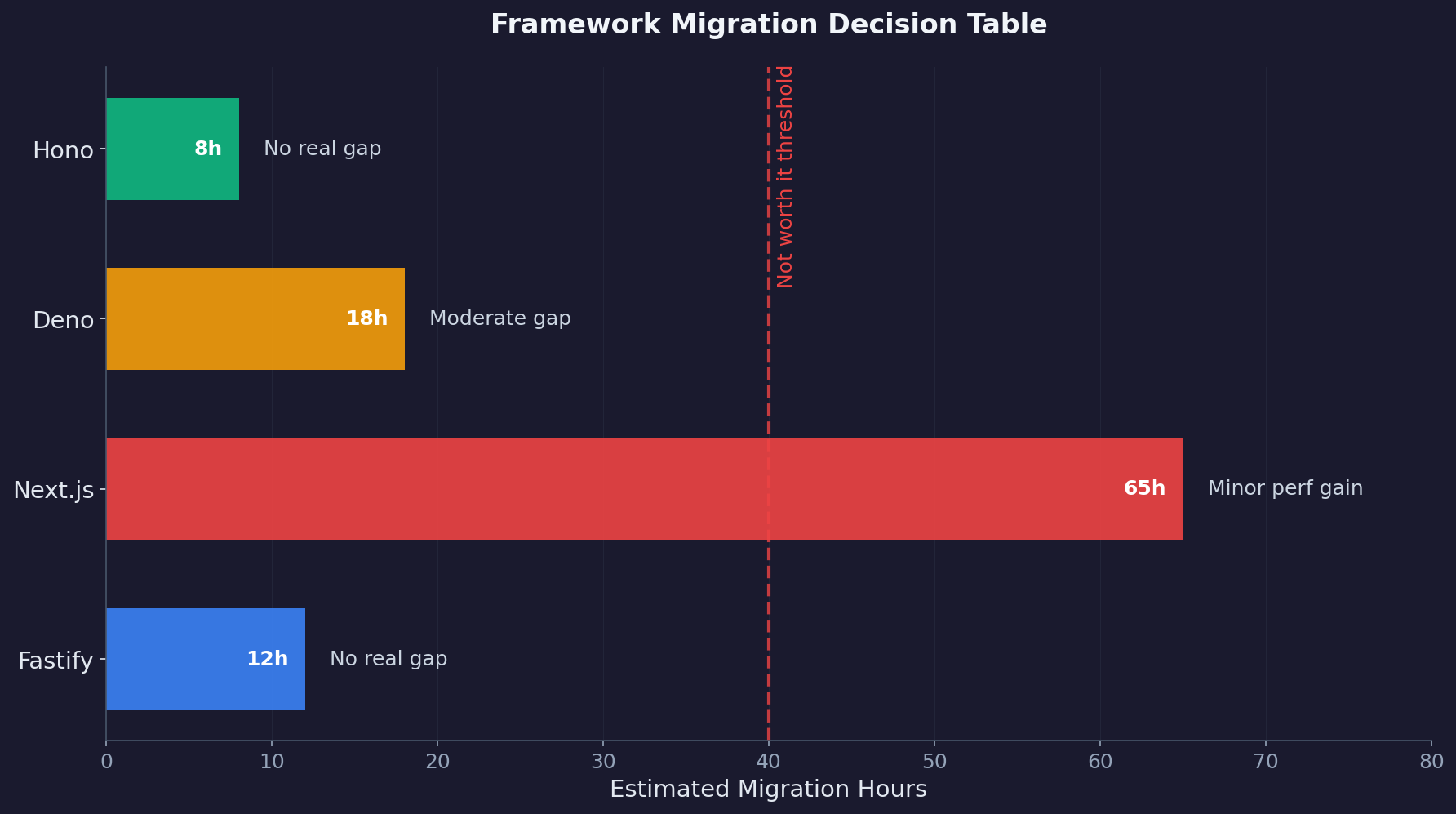
He stared at the whiteboard for ten minutes and produced two items — neither mattered for his endpoints serving JSON at 200 requests per second. We built a migration decision table instead. Columns: proposed framework, concrete capability gap, estimated migration hours, and number of routes affected. Rows filled with Next.js rewrites, Deno experiments, Hono evaluations. The pattern emerged fast — nearly every proposal was swapping one HTTP router for another with identical features under real load.
The savings compound across a team of eight developers. That Fastify detour would have cost us hundreds of engineer-hours plus regression testing on 47 endpoints with six service dependencies each. A warm feeling about shiny code. I track every declined migration now in a spreadsheet with timestamps and estimated effort avoided.
The running total hit months of collective developer time saved last quarter alone — time actually spent shipping features users touch rather than rewriting routes developers admire in pull requests.
The anchoring technique works because it flips the burden of proof back where it belongs: on the proponent to demonstrate necessity rather than novelty filling a resume bullet point. That will rot when the next hype cycle arrives three months later and they move onto whatever ships their weekend project fastest.
While your stable production systems keep earning revenue without another dependency bump emergency lurking in tomorrow’s changelog feed from npm registry you stopped reading weekly. Because trust eroded from that last minor version breaking your entire build pipeline on Friday afternoon before demo day arrived without warning or apology notice sent by maintainers who renamed exports overnight again.
I still reach for new frameworks. But I stopped letting them hijack my weekend calendar. Now I read the runtime before the README. It’s a 15-minute read, not a two-hour tutorial binge. That mental shift killed my tourist habits.
A recent YouTube video won’t teach you how to think like an engineer. The Merriam-Webster definition of “stop” just says “to suspend activity.” I needed stronger grammar. The question that broke my loop: will this knowledge matter in three years. If yes, invest Sunday. If no, bookmark and move. If the answer is no, I close the tab. If it’s yes, I reach for strace instead of Stack Overflow.
Keep Reading
- Self-Hosted GPT-4 Alternatives: Run LLMs Locally & Own Your Data
- How to Orchestrate 10+ AI Coding Agents in Parallel – Each Opens a PR
- NVIDIA KAI-Scheduler: From GPU Chaos to MLOps Competitive Moat
Your career isn’t built on how many boilerplate generators you’ve memorized. It’s built on how deeply you understand the machine underneath them. Frameworks come and go in eighteen-month hype cycles. Memory pages, cache lines, and syscall overhead haven’t changed in forty years. That asymmetry is where real use lives. Pick one primitive this week. Understand it until you can explain it without notes. Then watch how every other framework suddenly feels like decoration on top of something you already know.