Before you install another npm package “just-in-case,” consider whether the actual friction in your workflow is technical. I’ve been guilty of this more times than I want to admit. Three months ago, I reached for zod before writing a single validation rule, and then I never needed it. The pattern is seductive: a GitHub README promises to solve your pain with minified bytes, so you yarn add it without measuring what you actually lose.
That loss isn’t just bundle size or build time; it’s the cognitive overhead of maintaining an abstraction layer for a problem that might not exist. We are drowning in tooling that solves past-tense problems. Most devs reach for state management libraries before their component tree hits fifty files, or pull in full GraphQL stacks when three REST endpoints would do.
The costs compound silently: dependencies break on upgrades, API surfaces expand beyond comprehension, and the original use case becomes cargo-culted into every new project. isn’t anti-tool. I run my own GPU cluster for AI inference on bare metal, so trust me when I say the right abstraction saves weeks.
But I’ve learned to ask one brutal question before installing anything: Does this fix real friction, or does it just make me feel productive? What follows are specific cases. Where common tools hurt more than they help, patterns for identifying psychological tool-bloat before it calcifies into tech debt, and the hardest lesson of all: sometimes the best developer experience is deleting code nobody needs.
The GitHub Star Blindness
A high number of stars on a repository seduces engineers into rewriting things that work. I’ve watched teams abandon a battle-hardened Express API for Fastify because it ranked higher on a trending page, not because latency was actually hurting users. The Stack Overflow Developer Survey from last year confirmed what many suspected: developers actively seek newer tech even when their current stack satisfies every requirement. That’s not innovation — that’s tool addiction disguised as curiosity.
Basecamp’s DHH has been shouting into the void about this for years.
His Rails simplicity versus microservices schtick isn’t just nostalgia; it’s a documented case study in refusing unnecessary complexity. A small team at Basecamp runs one of the internet’s largest email services with less code than most startups’ authentication middleware. Nobody admits they switched tools for status.
But look at the justification: “maintainability,” “system momentum,” “future-proofing.” These are fancy words for “I want my LinkedIn to look relevant.” The real test is brutal. But clarifying: would you still pick this tool if nobody else knew you were using it? If the answer requires more than two seconds of thought, you’re solving an ego problem, not an engineering one.
No Framework Survives First Contact With Reality
Last month I watched a team spend their entire sprint rewriting tests after their state management library broke across versions. The original application worked fine. It had three button handlers and a single API call. The Stack Overflow survey numbers tell part of the story — respondents actively seek newer tech even when current stacks meet requirements. But the real problem runs deeper than curiosity.
It’s institutionalized FOMO disguised as technical due diligence. A startup I advised replaced Postgres with CockroachDB because “we’ll need global distribution eventually.” They had a small number of customers in a few states. The migration cost them weeks of engineering time and introduced connection pooling issues that took additional time to stabilize. Basecamp’s DHH called this years ago — developers choosing microservices over simplicity not because their problem demanded it, but because monoliths felt passé.
Rails powering Basecamp for many years proves the point better than any blog post ever could. The irony cuts sharpest at large organizations. Enterprise teams mandate Kubernetes because it’s what “real companies use,” then hire several SREs just to keep the control plane running for an API that serves a modest number of requests per minute. If you’re already running bare metal Kubernetes, you know the operational overhead I’m talking about.
I’ve watched teams deploy Serverless on Lambda only to discover cold starts made their user-facing endpoint slower than their old Express server.
The performance regression was measurable in seconds, not milliseconds. Build tool migration offers the clearest example. Moving from Webpack to Vite might save milliseconds on hot reloads, but the CI/CD pipeline rewrite takes days. Retraining juniors on new cache semantics takes weeks longer than anyone budgets for. These aren’t edge cases — they’re the standard outcome when technology selection becomes identity signaling instead of problem solving.
Every abstraction layer adds friction you don’t see until your deadline evaporates chasing compatibility patches.
The Economics of Abandonment
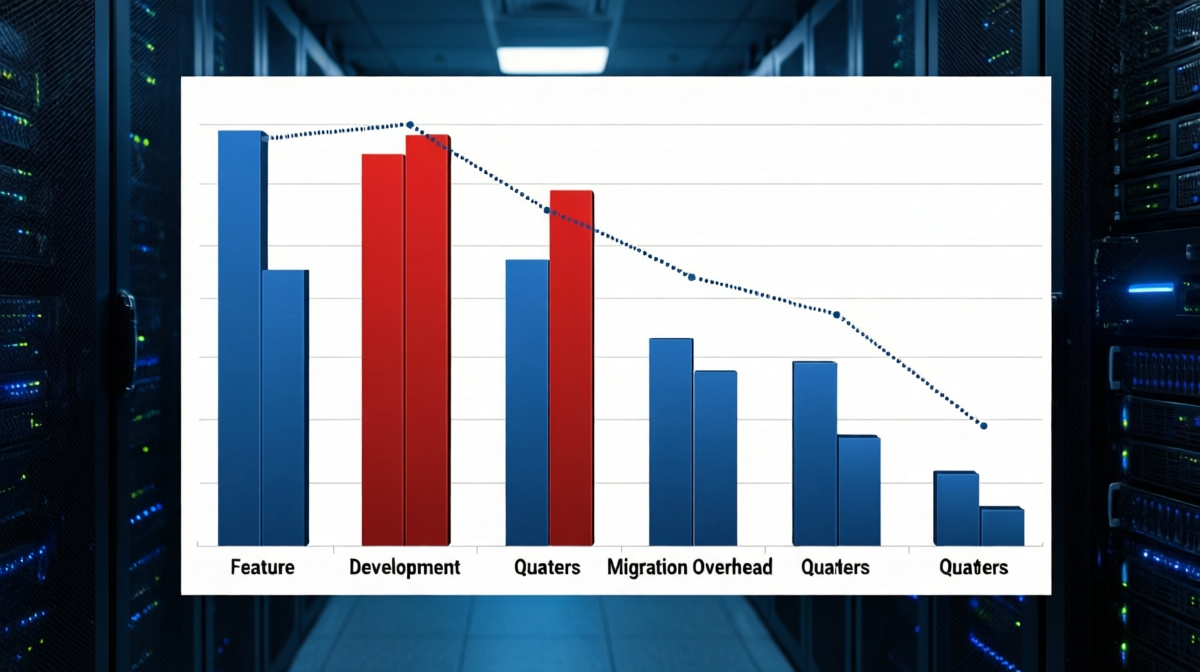
A team maintaining multiple different build systems (webpack, Vite, Turbopack, esbuild, and a custom Rollup config) isn’t shipping faster. They’re maintaining multiple sets of configuration files, each with its own breaking changes across minor version bumps. One team I observed spent a significant amount of time migrating from Jest to Vitest—only to discover the test coverage was identical and the performance gain was negligible.
Blind posts tell the same story across many companies. Engineers describe migrations that consumed a large portion of sprint capacity for an extended period. Same features, different import syntax. Teams rationalize these pivots as “technical debt reduction,” but the debt never shrinks—it just shifts to a new ledger system while customers wait for bug fixes on shipped products.
Framework churn creates what economists call sunk cost entrapment: once you’ve invested in migrating authentication logic (weeks), state management patterns (weeks), and deployment scripts (weeks), abandoning becomes harder than continuing. So teams double down on migrations with negative ROI rather than admitting the trade wasn’t worth making. Meanwhile, your competitor ships the actual feature users requested using plain TypeScript on Express.js running unchanged for a long period.
The Resume Stack Has a Half-Life
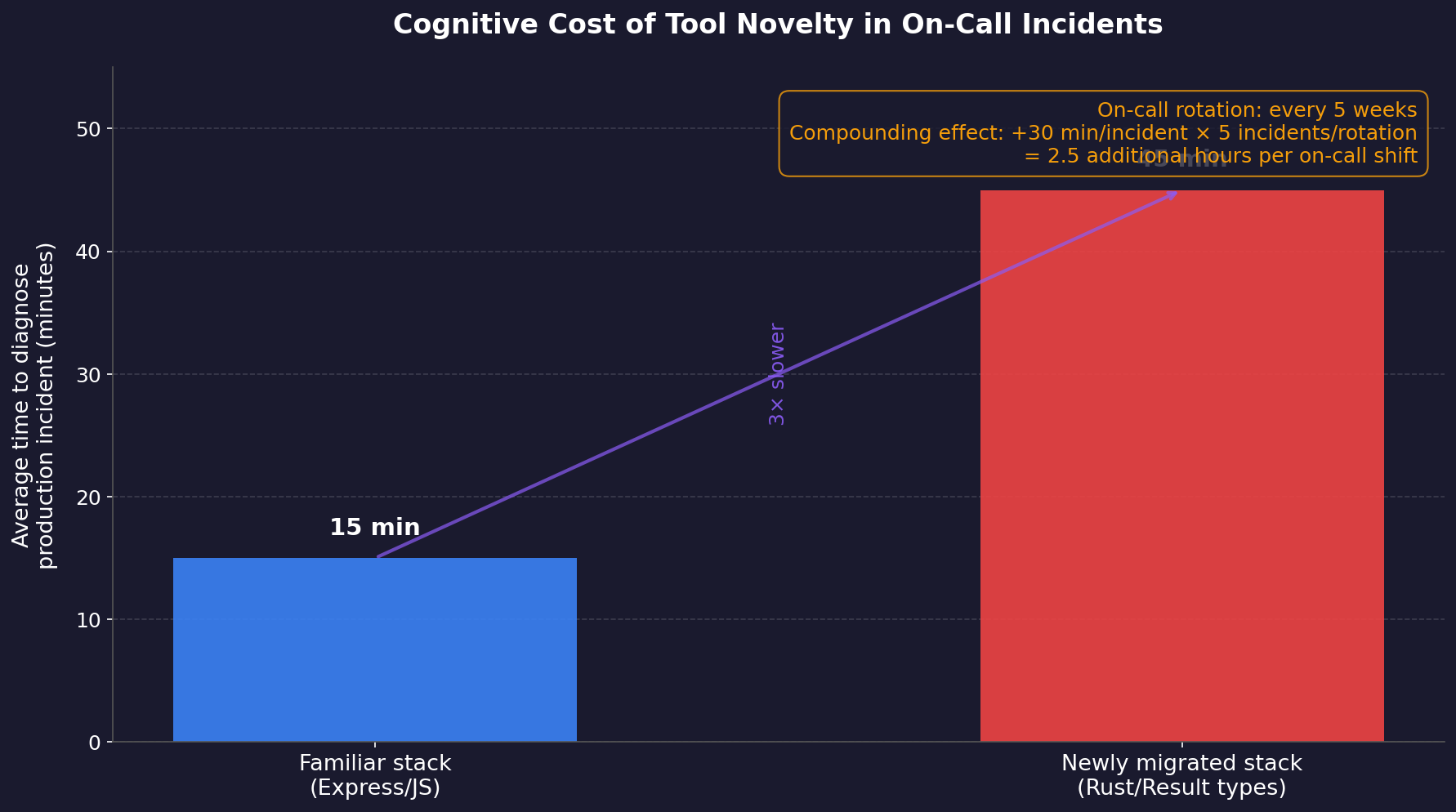
The signal-to-noise problem is measurable if you look at the right metrics. A friend shared anonymized sprint data from a mid-stage startup last quarter. After their infrastructure lead pushed through a language migration promoted as “performance modernization,” deployment frequency stayed flat for an extended period. Meanwhile, incident response time more than doubled on average. The culprit wasn’t the language itself. It was unfamiliar error handling patterns.
When a rotating on-call engineer gets paged at 2 AM and encounters Result types instead of thrown exceptions, they spend extra time just parsing the control flow. That delay compounds across a team of several rotating engineers who each touch this codebase every fifth week. Nobody learns it deeply enough to internalize the patterns. Research has documented this precisely: teams adopting technologies primarily for hiring use saw sprint predictability degrade significantly over time, while feature velocity remained statistically unchanged.
Blind posts tell an uglier story underneath the academic framing. Engineers regularly describe weeks wasted after major infrastructure pivots—migrations that shipped late, required emergency rollbacks, or simply never completed because the original champion left for another job before seeing it through. The cost isn’t abstracted into cloud bills or latency charts. It lives in slowed iteration cycles and increased mental overhead across every engineer who inherits someone else’s career-enhancing architecture choice.
The Vacuum Behind the Hype Cycle
The pattern is predictable now. A hot new runtime drops, many thinkpieces declare it “the future,” and every junior dev in your org opens a PR to port the authentication service. Nobody asked whether their existing setup was actually slow. I watched a team spend weeks migrating many microservices from Node.js to Go — only to discover their bottleneck was a single unindexed Postgres query. They never measured before they moved.
The migration made latency worse because someone rewrote the connection pooling wrong. It’s theater with deadlines. These decisions compound silently.
Every novel dependency you pull in means more surface area for supply chain attacks, more upgrade friction. When security patches land, and more tribal knowledge that walks out the door when the person who championed it quits for better pay at another hype-train company. I maintain a simple rule now: no production dependency younger than two years old unless we’re prototyping something disposable.
Haskell’s had many major releases since 2010 — most financial firms still run it on GHC 8.x because stability beats novelty every time. Your CI/CD pipeline doesn’t care how impressive your tech stack looks on LinkedIn. It cares about staying green under load while you sleep. If you’re constantly tempted by the next shiny thing, stop learning new frameworks every month and focus on depth instead.
This Is Where The Ice Breaks
This pattern of rapid, unexamined change isn’t confined to software. Polar bears aren’t dying because the ice melted too fast; they’re dying because they never had time to adapt. The Arctic Basin subpopulation is officially listed as Data Deficient by Polar Bears International—a classification that masks a grim reality: we don’t know exactly how fast they’re declining. Because the ice they depend on is vanishing before we can count them.
What we do know from recent tracking updates is brutal: spring hyperphagia—the critical feeding season where bears gorge on seal pups to survive the summer fast—is shifting earlier by roughly one week per decade in Hudson Bay. A bear that evolved to hunt in April now finds open water instead of pack ice.
That mismatch isn’t gradual. It’s a metabolic trap door opening under every female with cubs. Female polar bears can go up to eight months without eating during denning and fasting periods, surviving entirely on stored fat from spring hunting. If that spring window shrinks by even two weeks, she enters denning season with roughly 15–20% less body mass. Her cubs don’t make it through winter.
The Western Hudson Bay population—one of the most studied—has already seen a 30% decline since 1987, tied directly to earlier ice breakup.
The bears that adapt fastest aren’t the strongest or the biggest. They’re the ones that stop wasting energy on ice that no longer holds their weight. Your toolchain is that ice.
The same logic applies to your stack: the migration you’re planning today is a metabolic bet on a hunting ground that’s already gone. When the Western Hudson Bay population lost access to stable ice, the bears didn’t find a new prey source—they just starved slower. Your team will do the same if you keep porting services to frameworks that solve problems your metrics never measured.
Keep Reading
- Self-Hosted GPT-4 Alternatives: Run LLMs Locally & Own Your Data
- Voice-Controlled Multi-Agent Workflow for Claude Code in Tmux
- NVIDIA KAI-Scheduler: From GPU Chaos to MLOps Competitive Moat
The unindexed Postgres query that caused your latency spike is still there, untouched, while you rewrite connection pooling in a language your on-call rotation doesn’t fully understand. Every sprint spent on tool migration is a sprint not spent on the actual bottleneck. The ice breaks where you stand, not where you wish it held.