The multiplier nobody accounts for
Let’s start with the math that breaks systems.
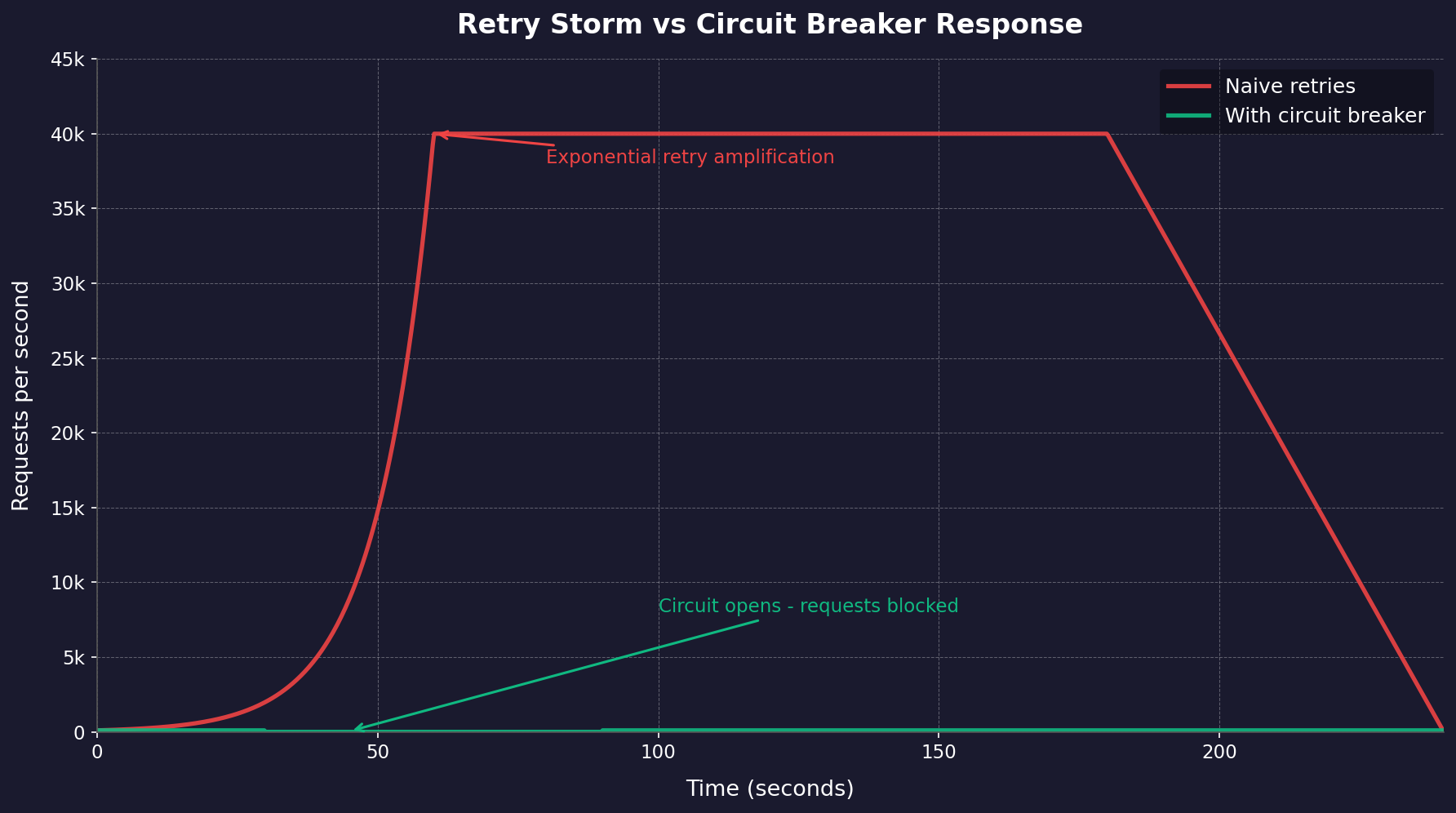
A single timeout at 11:47 AM on Black Friday triggered 40,000 identical retries from our checkout service within seconds. Every client thread saw the same slow payment gateway and re-attempted the exact same doomed request simultaneously. The database connection pool saturated in under a minute. Here’s what the postmortem showed: we had configured timeouts correctly. We had connection limits.
What we lacked was any protection against retry storms. The default HTTP client retry policy in our stack would re-fire requests up to three times per thread, and with hundreds of checkout threads, that turned one latency spike into thousands of queries hammering PostgreSQL. AWS documentation covers this exact failure mode for throttling errors. When you retry immediately after receiving a ThrottlingException, you’re not just wasting a request; you’re amplifying the load that caused the throttle in the first place.
Our four-minute outage wasn’t caused by the payment provider’s hiccup. It was caused by our own code multiplying that hiccup into a self-inflicted denial of service. The pattern is embarrassingly simple: latency spike hits, every idle thread picks up a queued request, they all fire at once, and what should have been a brief blip becomes cascading failure across dependent services.
No circuit breaker meant no coordination between those retrying threads; each one operated in isolation, convinced it was being helpful. That’s why tutorials fail us here. They teach you to set a timeout and move but production traffic doesn’t read tutorials. It reads your configuration and exploits every gap it finds.
The fix requires treating resilience as an architectural concern, not a client-library checkbox—which is exactly what circuit breakers, backoff strategies, and bulkheads give us once we stop bolting them on after incidents like this one force our hand.
The retry storm follows a predictable arc.
One service stutters, and its HTTP client retries immediately, say 3 times with a 50ms backoff. Those retries land on a connection pool sized for normal traffic—200 sockets per host. The pool drains in seconds. Every queued request now waits behind the retries. Unrelated services sharing that downstream dependency start timing out at their own thresholds, usually 2 seconds.
Their clients retry too. Within one minute, you’ve turned a single slow database query into a fleet-wide outage that no longer has anything to do with the original query. The numbers get ugly fast. A service handling 1,000 requests per second with a 5% error rate and 3 retries suddenly injects an extra 150 requests per second into the failing dependency.
If that dependency is already degraded, each attempt costs more latency than the last. I’ve seen postmortems from major outages where default HTTP client behavior was the accelerant. AWS’s own documentation on throttling errors makes this explicit: immediate retries on ThrottlingException responses amplify the throttle condition because every rejected call consumes server-side resources before the rejection is generated. Connection pools are the silent amplifier here.
When your pool exhausts—say all 100 connections are stuck waiting on responses—new requests block instead of failing fast. That blocking holds threads hostage while upstream clients grow impatient and fire their own fresh attempts. The fix isn’t to stop retrying entirely; it’s to make retries exponentially less frequent and jittered relative to real failure modes. Your first retry shouldn’t happen before you know whether your peer is broken or just breathing hard.
From the database’s perspective, that traffic was indistinguishable from a DDoS assault. No distinction exists between malicious floods and well-intentioned duplicates at the connection-pool level. The retry math compounds brutally.
One hundred users each triggering 400 automatic re-attempts produces the same signature as a coordinated botnet hitting your endpoints. The service you’re trying to reach doesn’t care whether you’re an attacker or a frustrated customer. It just sees more work piling onto an already saturated queue. Java 11’s HttpClient defaults make this worse by design.
The synchronous API offers no circuit-breaking logic out of the box; your code either implements backoff explicitly or inherits whatever naive loop you wrote in three minutes during a hackathon sprint.
Circuit breakers exist precisely because engineers cannot be trusted to write these thresholds by hand mid-incident. The uncomfortable truth is that timeouts alone are insufficient guards. A timeout tells you the request failed; it says nothing about whether retrying immediately is safe. Production systems need both layers: a breaker that refuses calls entirely after 5 consecutive failures, plus backoff logic that stretches intervals with full jitter so synchronized recovery attempts don’t slam the door shut again.
That four-minute outage taught us something cheaper than any training course: protect your dependencies before they fail, not after your dashboard turns red across every tenant sharing that database cluster.
The tri-state machine that survives production
The binary breaker is a lie we tell ourselves.
A single dependency hiccup for thirty seconds is all it takes to expose the flaw. When your service goes down, every downstream caller retries at once, and that coordinated burst can escalate a brief blip into a full regional outage. Netflix’s Hystrix documentation settled this years ago by adding a third state: half-open. In that state, a trickle of traffic—say, 5% of requests—probes the recovering service without releasing the full flood.
This design works because recovery is probabilistic, not binary; you need evidence before trusting the system again.
You allow one request through. If it succeeds, you close the circuit gradually. If it fails, you snap back to open and reset the timer. The Google SRE workbook spells out tuning knobs: minimum requests before opening, sleep window duration, and error threshold percentages that shift with downstream recovery patterns. The statistical trap hides in quiet services.
A dependency handling five requests per minute makes a 50% error threshold meaningless. Two unlucky failures snap the tripwire during off-peak hours. USENIX fault-injection literature documents this repeatedly: minimum request volumes must gate decisions so insignificant samples never trigger cascading failures. Martin Fowler’s original article on circuit breakers still holds as the foundation. Modern variations just add finer granularity.
I run per-dependency thresholds configured independently. Payment gateway gets aggressive settings—three failures in ten seconds opens immediately, since retries cost money and customer trust. Internal metadata service gets lenient ones: twenty failures over sixty seconds before tripping, because transient blips are common and false positives outweigh brief degradation. The half-open probe count matters more than engineers expect. One probe risks mistaking latency spikes for recovery; ten probes hammer a struggling service back into failure mode.
The dashboard told the truth: fifteen microservices, one checkout database, zero shared trip settings.
Blanket configurations were the original sin. I started with Hystrix’s tri-state model but discarded its default cutoffs almost immediately. A payment gateway that fails 2% of the time needs a different trigger point than an inventory service that fails 0.1%. I now set failure ratio limits per client using historical error rates from the past 30 days of metrics. Not global constants; per-client numbers backed by measured data instead of guesses. Slow calls deserve their own counter.
Exceptions can stay rare while latency quietly degrades. A 200ms p95 creeping to 1.
The fair objection to fail-fast
That rollout order sounds tidy, but the sharpest criticism of circuit breakers is that they turn a degraded dependency into a hard outage. When the breaker trips, you’re no longer serving slower responses; you’re rejecting requests outright. Monitoring sees a spike in 503s, someone pages the on-call engineer, and incident response spins up for what was originally a 200ms latency blip in one upstream service.
I’ve watched this happen. The fix isn’t abandoning breakers; it’s calibrating the half-open state properly. A half-open breaker doesn’t flip back to fully closed after one successful probe; it lets through a trickle of traffic and evaluates results. Set that probe interval based on your dependency’s recovery characteristics, not an arbitrary default. If your payment gateway historically recovers within 30 seconds, configure the half-open window at 45 seconds with probe concurrency of 2 or 3 requests.
That tiny sample tells you whether the dependency is healthy without flooding it with full production load. Does this mechanism mask real outages if you configure it poorly? A breaker with an aggressive threshold trips during transient hiccups, hiding genuine degradation behind fast failures. But masking is preferable to amplifying: a retry storm from 40k identical requests takes down adjacent services through shared connection pools.
Four minutes of site-wide outage from one latency spike is amplification; four minutes of clean 503s with detailed metrics is honest signal by comparison. The calibration burden is real. I won’t pretend otherwise. You need per-dependency thresholds, alerting on state transitions rather than raw error rates, and disciplined reviews whenever thresholds fire spuriously. Treat breaker configuration as operational debt reviewed quarterly against incident data.
Keep Reading
- Self-Hosted GPT-4 Alternatives: Run LLMs Locally & Own Your Data
- Voice-Controlled Multi-Agent Workflow for Claude Code in Tmux
- NVIDIA KAI-Scheduler: From GPU Chaos to MLOps Competitive Moat
Resilience tooling that hides problems is dangerous; tooling that converts cascading chaos into contained failure does its job when tuned honestly with visible transitions throughout. That containment is exactly what the tri-state machine and per-dependency thresholds deliver—and it’s what makes the difference between a service that degrades gracefully and one that turns a single 200-millisecond hiccup into four minutes of total darkness.