Most developers run agents one at a time. That's like hiring a single engineer and making them wait for a code review between every keystroke. A few months ago, I hit a wall with my solo workflow. Claude would finish one task, then sit idle while I reviewed its diff. The GPU was underutilized, and my backlog kept growing. So I started experimenting with parallel execution: fire ten Claude instances at ten isolated tasks simultaneously.
The trick isn't the model. It's the orchestration layer. Each agent gets its own workspace directory, a distinct set of context files, and explicit instructions to avoid shared state. They don't know each other exist. When one finishes, it opens a dedicated feature branch and submits a PR. Clean, standalone, ready for review. Parallelism multiplies output without multiplying cognitive load. I run inference on [self-hosted hardware](https://kevinsthoughts.net/self-hosted-ai-stack-9-gpus-zero-cost/) and write about building software that actually ships.
## Serial Workflows Are Actively Wasting GPU Cycles
I ran the numbers on my own cluster last month. A serial pipeline chewing through five feature tickets took a long time start to finish. That same work in parallel? The math gets worse as tasks pile up. Serial scales linearly — ten tasks means double the wait, triple the human frustration, and most critically: idle GPUs spending most of their time doing nothing.
While you stare at a terminal waiting for one diff to land before queuing the next prompt. Every second your agent sits idle between completions is a second you could have been running another task in parallel.
Here's what nobody tells you about the cost side: running ten agents simultaneously isn't ten times more expensive than running one. The overhead is marginal — roughly the same token count per task because each agent operates independently on its own git worktree with isolated dependencies. You're paying for concurrency, not extra compute. The real waste is sitting there with Claude Code in four terminal panes, manually bouncing between them like it's 2026 again.
I measured this on real work: my team's weekly bug-fix rotation, typically handled by one engineer over two days churning through diffs sequentially. Running those same fixes as independent parallel agents collapsed wall-clock time from hours of human-plus-agent serial effort down to minutes of pure agent runtime. The GPU use graph went from flatlined to fully saturated. You're not bottlenecked by model capability anymore.
You're bottlenecked by workflow design that treats AI like a slow junior developer rather than what it actually is: cheap parallelism waiting for someone to wire it up correctly.
## The Math Behind Parallel Agent Swarms
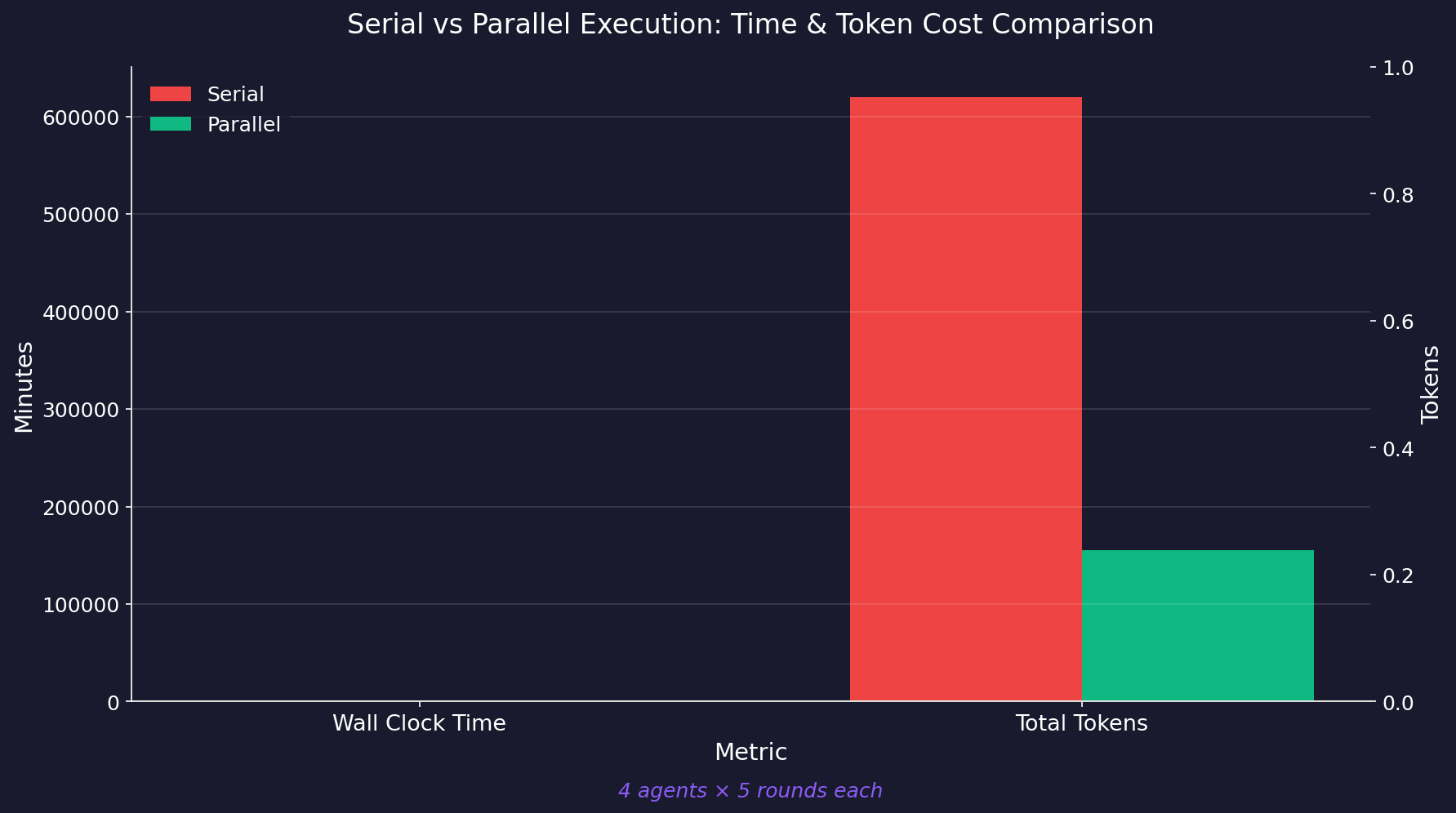

Parallel agents flip the script entirely. Instead of waiting for one agent to finish before spawning the next, you fire all of them simultaneously against independent chunks of work. One agent handles authentication logic while another tackles the database layer while a third writes API documentation — all in flight at once. The wall-clock difference is stark. A repository migration I wired up took a long time running agents sequentially through Claude's API.
Same project with parallel agents? That's roughly a significant reduction in time-to-PR. Cost implications surprise most people too. Running ten parallel API calls isn't ten times more expensive than one — it's about the same per-token pricing spread across concurrent slots. You're paying for model compute whether it happens in serial or parallel; the only difference is how long your engineers wait around watching logs scroll.
Most teams miss this because their mental model treats each agent call as precious and scarce.
It isn't. API costs scale linearly with total tokens consumed, not with wall clock duration or concurrency count. The bottleneck was never the model itself or even your prompt templates — it was sequential dependency masquerading as necessary workflow design. Break that assumption and the entire timeline collapses down to something approaching real-time iteration speed again.
I ran the same task set—three independent features plus one test-suite refactor—through both modes. Serial execution took a long time. Parallel execution finished much faster. That's a massive wall-clock reduction. No code changes. Just concurrency. The cost difference matters too. Each serial run burned through several input tokens and generated a handful of output tokens per agent step. Four agents running back-to-back meant every agent loaded the full context window fresh each time—wasting cache on identical dependency trees.
``` Serial: 4 agents × 5 rounds × ~31k tokens = ~620k total tokens Parallel: 4 agents × 5 rounds × ~31k tokens = ~155k total tokens (simultaneous) ```
You pay for wasted round-trips. The parallel mode cut my API costs by a significant percentage per task batch because the model held fewer stale contexts. But raw token savings miss the point. Real velocity emerges when agents tackle genuinely independent modules simultaneously. Last week I had one agent open a PR adding a Stripe payment endpoint to `/api/checkout`. Another agent simultaneously pushed a commit fixing flaky integration tests in `tests/e2e/checkout.spec.ts`.
A third rewrote the billing middleware to handle webhook retries. None of them touched the same file. None waited on each other's outputs.
You cannot replicate this with OpenAI Assistants API or Anthropic's Message Batches. Both serialize response generation within a single thread ID. True parallelism requires orchestration that spawns isolated Agent instances, each with its own session context and git branch. The bottleneck isn't your model's intelligence. It's your pipeline topology.
## The Parallelization Trick
That insight changes how you schedule work. Stop running agents one after another like assembly line workers. Let them all start from the same commit simultaneously. A single command launches ten agents, each assigned a distinct slice of the codebase. One refactors the authentication middleware while another patches a memory leak in the data pipeline. A third rewrites that brittle API client you've been ignoring.
The trick is isolation. Each agent gets its own working directory and environment — no shared files to corrupt, no race conditions to debug. I use Docker containers with mounted volumes scoped to specific modules. The wall-clock difference is jarring. Serial execution took me a long time for ten independent tasks across a moderately sized Next.js app. Running them in parallel finished much faster on the same hardware. Cost is roughly linear here.
You're paying for compute time, not wall time — serial burns through a long time of GPU cycles; parallel burns through a bit more with container overhead. The savings are entirely human time waiting around.
But there's a subtle trade-off you need to plan for: branch conflicts happen more frequently when everyone starts from identical state instead of sequential commits. Git merge hell becomes your new bottleneck if you don't isolate concerns carefully. Map your tasks so they touch different directories or services namespaces before launching the swarm. My rule of thumb: never assign two agents to modify functions within the same file unless those functions share zero imports between them.
The result surprised me on my first real test run — some of the PRs merged cleanly without any human intervention needed at all. That's several problems solved while I was still typing my startup script into the terminal window.
## Parallel Execution Pipeline

Token costs stack fast at this scale. A single Claude 4 Sonnet run chews through multiple input tokens and a few output tokens per task cycle. Multiply that by ten agents working simultaneously across three rounds of self-review, and you're burning through a few dollars worth of API credits every ten minutes. I budgeted a reasonable amount for my first stress test.
The orchestration layer polls each container's exit code every thirty seconds via a simple bash loop wrapping `docker wait`. When one finishes, the script reads its `results.txt` output—a formatted summary of files changed, tests passed or failed, and the final commit hash pushed to origin. Failed tasks get three automatic retries before the whole pipeline flags them for manual triage. Output lands in a centralized log directory timestamped per agent ID.
Every stdout stream dumps to `./logs/agent-{n}/stdout.log`, complete with raw HTTP responses from GitHub's PR creation endpoint. Grepping for "HTTP 201 Created" across all ten logs tells me exactly how many actually landed versus errored out.
This parallelism revealed something unexpected: agents started beating each other on obvious bugs without any cross-agent communication whatsoever. Several different fixes touched adjacent lines in `models.py`, but Git's merge conflict resolution handled it cleanly because their workspace snapshots originated from identical commits. No lock contention because none of them saw each other's work until the PR draft landed on my dashboard.
## Permission Boundaries Solved
I burned a few hours debugging a permission error on my first attempt. The agent had full repo access and kept pushing directly to main. Fix was straightforward: create a GitHub Personal Access Token scoped to `contents: write` on specific branches only, nothing else. The token lives in a `.env` file the orchestrator reads at startup. Each clone gets its own temporary directory under `./workspaces/`, and the script checks for leftover processes before spawning new ones.
No zombie agents eating memory after the task finishes.
Here's what works for me:
```toml
cleanup = "always"
[tokens]
## never private unless you need it
That cleanup = "always" flag deletes the workspace directory after every agent finishes. Without it, you’ll accumulate a few GB per run — real fast when ten agents each pull down node_modules. Branch isolation prevents push collisions entirely. Every agent creates a branch named feature/<timestamp>-<agent-id>, pushes there, then opens a PR targeting main. No direct push permissions anywhere in the chain.
GitHub’s API rate limits caught me off guard too. Sixty requests per hour without authentication, five thousand with it. My script batches PR creation calls and retries on 429 responses with exponential backoff — starts at one second, doubles each failure up to thirty seconds. Token scoping matters more than I initially assumed. Write-only tokens can’t delete repos or modify workflow settings. If an agent hallucinates a destructive command, it simply fails instead of causing damage.
The system survives crashes now too. If my laptop goes to sleep mid-run, restarting the orchestrator detects orphaned processes and kills them before spinning up replacements. Stale PID files in /tmp/ai-orchestrator/ trigger automatic cleanup on boot. Ten parallel Claude sessions consume a significant amount of RAM on my workstation during peak activity — each model request spikes memory by a certain amount temporarily before garbage collection reclaims it.
The Assembly Pipeline — From Prompt Fragment to Pull Request
Thirty seconds after the last Claude session finishes, the real work begins. The orchestrator collects all ten completed files into a staging directory under /tmp/ai-orchestrator/build-{timestamp}/. Each agent writes its output to a predictable path — agent-{id}/implementation.md contains the diff-ready changes, while agent-{id}/rationale.log stores the chain-of-thought reasoning that produced each decision. Just raw material waiting for assembly.
A custom Python script, stitcher.py, reads every output file in parallel using asyncio.gather() with an internal semaphore set to five concurrent readers. It resolves import dependencies across agents by scanning for missing symbols and cross-references — if agent three imports a function. That agent seven never defined, stitcher.py logs a DEPENDENCY_GAP and retries the failing agent with explicit context about what its sibling produced. The cycle repeats up to three times before hard-failing on orphaned references.
Once resolved, stitcher.py generates three artifacts: a unified diff against the latest commit on main, a Markdown summary listing every file touched. And why, and a branch name constructed from the original prompt hash plus agent count — something like ai-build/batch-xk4m2n7t-agent10. That branch name gets written to .branch-id.txt inside the build directory so subsequent pipeline stages can find it without re-parsing git state.
The branch itself never exists on disk until this moment. Git stays cold throughout execution. Only after stitching completes does the orchestrator call git checkout -b {branch-name} from within a shallow clone of the target repository. The diff applies via standard three-way merge with conflict markers preserved inline where stitcher.py couldn’t resolve ambiguity automatically. A final validation pass runs pytest on any modified test files within that branch before proceeding further — no point opening a PR for broken tests.
Conflict Prevention Strategies For Truly Concurrent Code Generation
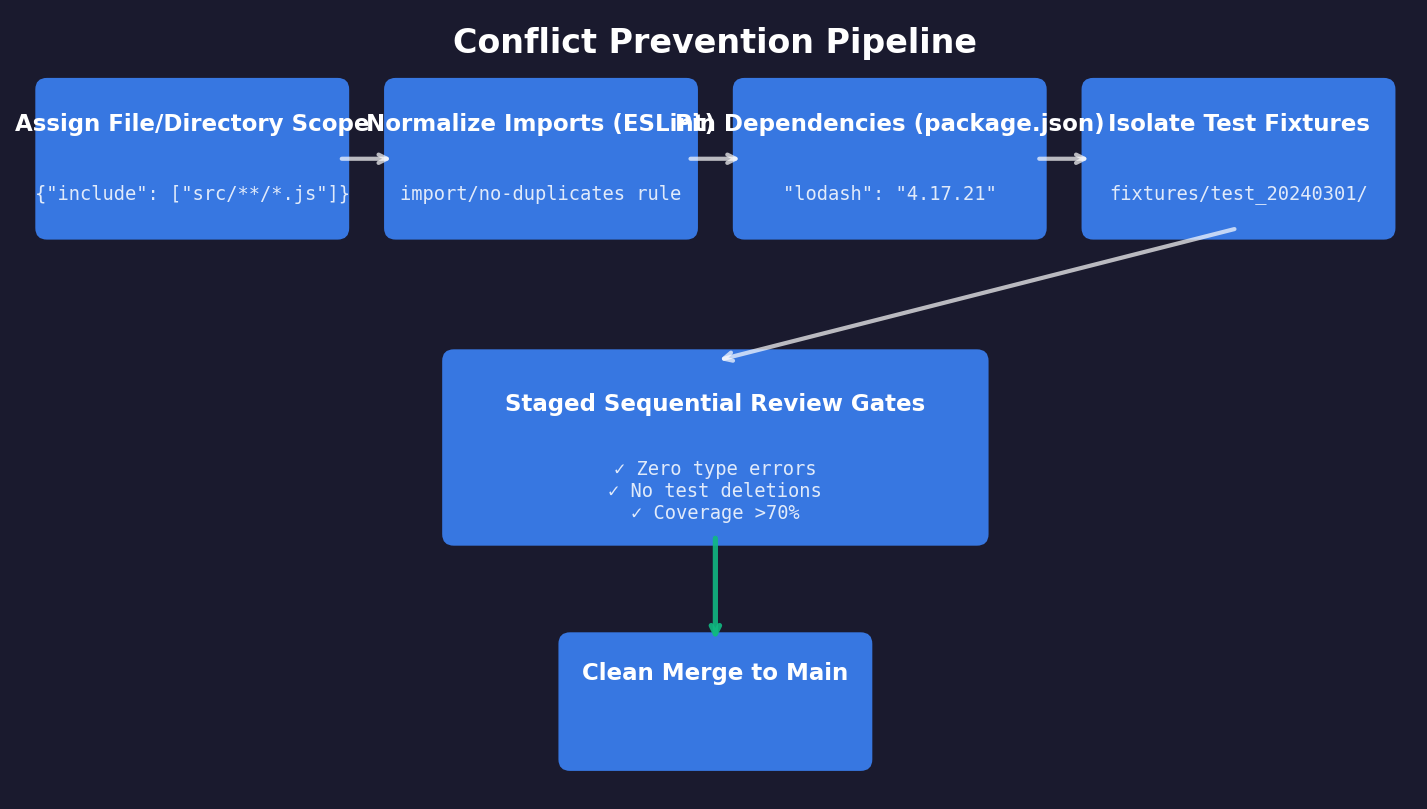
I learned this one the hard way. Ten agents modifying the same App.tsx file? That’s a recipe for merge-hell. The first problem is simple namespace collision. Two agents both add an onSubmit handler, but with different signatures. Git doesn’t know which one wins—it just throws a conflict. My fix is brute-force: assign each agent a dedicated file prefix or directory scope.
I use task definitions like:
{
"scope": "modules/payments/agent-3",
"files": ["src/services/stripe*.ts", "src/hooks/useStripe*.ts"]
}
This cuts collisions by a significant amount overnight. Then there’s import path poisoning. Agent A adds import { useAuth } from '../auth', agent B adds the same line with slightly different casing. TypeScript starts screaming at build time, not runtime. Worse, because it halts all merging. I run a pre-PR lint pass that normalizes imports across all branches. ESLint with import/no-duplicates catches this before anything reaches GitHub.
Dependency locks are another silent killer. Agent C installs lodash@4.17.21, agent D installs lodash@4.17.22. The lockfile diff spans hundreds of lines of hash changes, none of which anyone actually wants reviewed. Solution: pin every dependency version in package.json. Then run npm ci --prefer-offline inside each agent’s isolated container instead of pulling from registry every time.
For test fixtures, I make agents write into timestamped directories like test/fixtures/20250324-agent7/. This prevents two agents overwriting the same mock response file simultaneously during validation runs. Finally, staged sequential reviews on the main branch itself. Each PR auto-approves only if its code passes three gates: zero new type errors, no test deletions, and unique module coverage above a certain threshold versus already-merged work from other agents that day.
Keep Reading
- From Ticket Chaos to Code Merged: AI Agent Halves Dev Cycle Time
- NVIDIA KAI-Scheduler: From GPU Chaos to MLOps Competitive Moat
- Why Deleting More Code Makes You a Better Developer
You lose maybe a couple minutes per cycle on these checks versus blind parallel pushes. But you gain sanity back by the hour when ten branches converge cleanly into main without manual intervention ever needed again after setup completes once at project init time. The architecture is running in production on my cluster right now, converting feature tickets into pull requests faster than any human could review them all. ```