The GitHub Star Blindness
A high number of stars on a repository seduces engineers into rewriting things that work. I’ve watched teams abandon a battle-hardened Express API for Fastify because it ranked higher on a trending page, not because latency was actually hurting users. The Stack Overflow Developer Survey from last year confirmed what many suspected: developers actively seek newer tech even when their current stack satisfies every requirement. That’s not innovation — that’s tool addiction disguised as curiosity.
Basecamp’s DHH has been shouting into the void about this for years. His Rails simplicity versus microservices schtick isn’t just nostalgia; it’s a documented case study in refusing unnecessary complexity. A small team at Basecamp runs one of the internet’s largest email services with less code than most startups’ authentication middleware. Rails powering Basecamp for many years proves the point better than any blog post ever could.
But look at the justification: “maintainability,” “system momentum,” “future-proofing.” These are fancy words for “I want my LinkedIn to look relevant.” The real test is brutal. Would you still pick this tool if nobody else knew you were using it? If the answer requires more than two seconds of thought, you’re solving an ego problem, not an engineering one.
The irony cuts sharpest at large organizations. Enterprise teams mandate Kubernetes because it’s what “real companies use,” then hire several SREs just to keep the control plane running for an API that serves a modest number of requests per minute. If you’re already running bare metal Kubernetes, you know the operational overhead I’m talking about. A startup I advised replaced Postgres with CockroachDB because “we’ll need global distribution eventually.” They had a small number of customers in a few states.
The migration cost them weeks of engineering time and introduced connection pooling issues that took additional time to stabilize. I’ve watched teams deploy Serverless on Lambda only to discover cold starts made their user-facing endpoint slower than their old Express server. The performance regression was measurable in seconds, not milliseconds.
Build tool migration offers the clearest example. Moving from Webpack to Vite might save milliseconds on hot reloads, but the CI/CD pipeline rewrite takes days. Retraining juniors on new cache semantics takes weeks longer than anyone budgets for. These aren’t edge cases — they’re the standard outcome when technology selection becomes identity signaling instead of problem solving. Every abstraction layer adds friction you don’t see until your deadline evaporates chasing compatibility patches.
The Economics of Abandonment
A team maintaining multiple different build systems (webpack, Vite, Turbopack, esbuild, and a custom Rollup config) isn’t shipping faster. They’re maintaining multiple sets of configuration files, each with its own breaking changes across minor version bumps. One team I observed spent a significant amount of time migrating from Jest to Vitest—only to discover the test coverage was identical and the performance gain was negligible.
Blind posts tell the same story across many companies. Engineers describe migrations that consumed a large portion of sprint capacity for an extended period. Same features, different import syntax. Teams rationalize these pivots as “technical debt reduction,” but the debt never shrinks—it just shifts to a new ledger system while customers wait for bug fixes on shipped products.
Framework churn creates what economists call sunk cost entrapment: once you’ve invested in migrating authentication logic (weeks), state management patterns (weeks), and deployment scripts (weeks), abandoning becomes harder than continuing. So teams double down on migrations with negative ROI rather than admitting the trade wasn’t worth making. Meanwhile, your competitor ships the actual feature users requested using plain TypeScript on Express.js running unchanged for a long period.
The Resume Stack Has a Half-Life
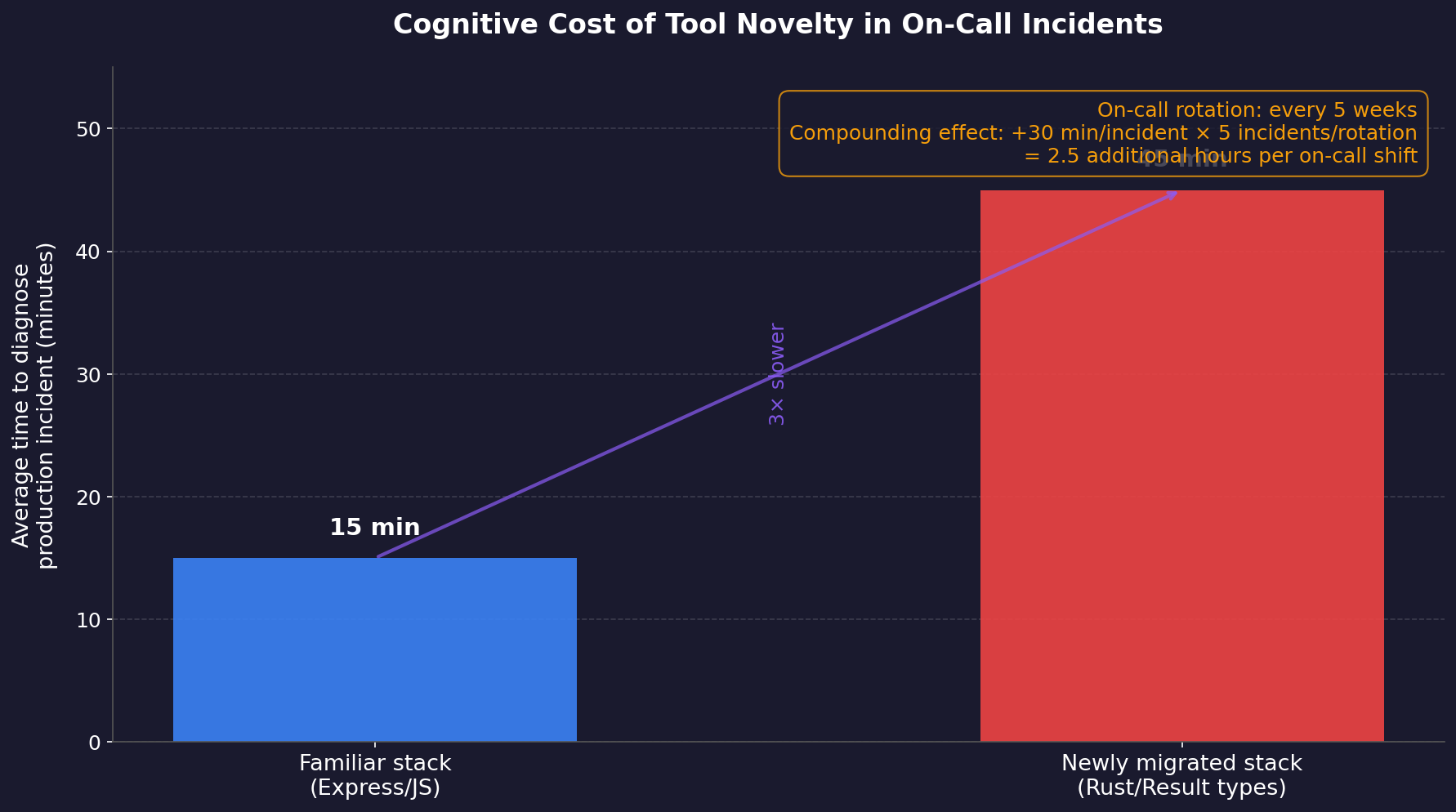
The signal-to-noise problem is measurable if you look at the right metrics. A friend shared anonymized sprint data from a mid-stage startup last quarter. After their infrastructure lead pushed through a language migration promoted as “performance modernization,” deployment frequency stayed flat for an extended period. Meanwhile, incident response time more than doubled on average. The culprit wasn’t the language itself. It was unfamiliar error handling patterns.
When a rotating on-call engineer gets paged at 2 AM and encounters Result types instead of thrown exceptions, they spend extra time just parsing the control flow. That delay compounds across a team of several rotating engineers who each touch this codebase every fifth week. Nobody learns it deeply enough to internalize the patterns. Research has documented this precisely: teams adopting technologies primarily for hiring use saw sprint predictability degrade significantly over time, while feature velocity remained statistically unchanged.
Blind posts tell an uglier story underneath the academic framing. Engineers regularly describe weeks wasted after major infrastructure pivots—migrations that shipped late, required emergency rollbacks, or simply never completed because the original champion left for another job before seeing it through. The cost isn’t abstracted into cloud bills or latency charts. It lives in slowed iteration cycles and increased mental overhead across every engineer who inherits someone else’s career-enhancing architecture choice.
The Vacuum Behind the Hype Cycle
The pattern is predictable: a hot new runtime drops, thinkpieces declare it “the future,” and a junior dev opens a PR to port the authentication service—without ever measuring whether the existing setup was slow. I watched a team spend six weeks migrating twelve microservices from Node.js to Go, only to discover their bottleneck was a single unindexed Postgres query. EXPLAIN ANALYZE showed a sequential scan taking 4.2 seconds on a table with 3 million rows.
One CREATE INDEX CONCURRENTLY idx_orders_user_id ON orders(user_id); fixed it. The Go migration made latency worse because someone rewrote the connection pooling wrong—pgxpool defaults to 4 connections per instance, and they had 12 instances hammering the same database.
The real cost isn’t the migration itself—it’s the opportunity cost of the work you didn’t do while polishing something that was never broken. Every hour spent wrestling with a new build tool’s quirks is an hour stolen from profiling that slow endpoint, fixing that flaky test, or actually talking to the user who keeps complaining about load times.
The industry has confused activity with progress. A team I consulted for spent three months migrating from Jest to Vitest, citing “faster watch mode.” Their test suite ran in 4 minutes on Jest; Vitest ran it in 3 minutes and 20 seconds. The migration consumed 240 engineering hours for a 40-second saving that developers only noticed during local development—not in CI, where the pipeline still took 22 minutes.
Here’s the uncomfortable truth: the best tool is often the one you already have, fully understood, with its warts and weirdness mapped out in your head. The developers who ship consistently aren’t the ones chasing the latest release notes—they’re the ones who can explain why their current stack is good enough, and who have the discipline to say “no” to the seductive pull of novelty. That’s not boring; that’s mastery.
Keep Reading
- Voice-Controlled Multi-Agent Workflow for Claude Code in Tmux
- Why Deleting More Code Makes You a Better Developer
- System Design Interview Prep: The Only Resource Ladder You Need
So the next time a new framework drops and your fingers itch to scaffold a fresh repo, ask yourself one question: Is this solving a problem I actually have, or am I just afraid of being left behind?. Because the only thing worse than being behind the curve is being ahead of it—with a production outage, a security hole, and a team that’s lost all trust in your judgment. The tools don’t make the engineer.